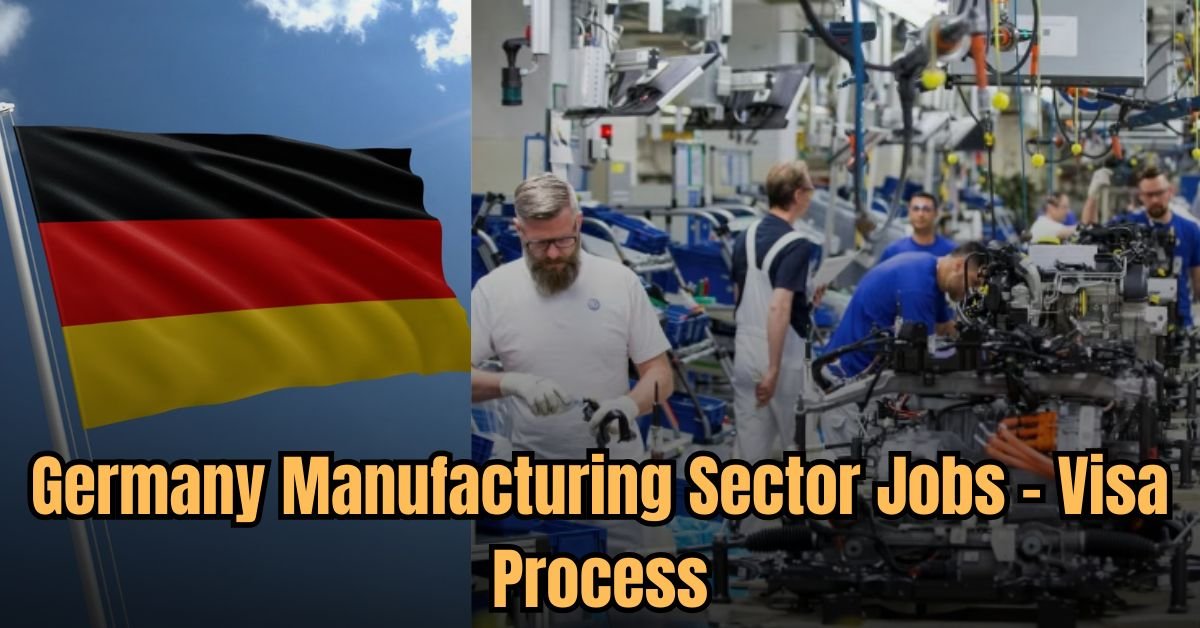
Elevate Your Career: Germany’s Manufacturing Jobs and Visa Process Guide (2025)
Are you an engineer, a skilled technician, or a manufacturing specialist looking to take your career to new heights? Germany, the industrial heart of Europe, is currently facing a severe shortage of workers and professionals. There are more than 1.3 million vacancies in its world-renowned manufacturing sector.
Whether you are a CNC expert from India or a mechanical engineer from Pakistan, the 2024 and 2025 updates to the Skilled Immigration Act have made it easier than ever to secure a high-paying job at institutions like BMW, Siemens, and Bosch. This guide will show you how to navigate the job market and utilize new visa pathways, particularly the Chancenkarte (Opportunity Card).
1. The 2025 Landscape: Why Germany Needs You
Manufacturing accounts for nearly 20% of Germany’s total GDP. However, due to the retirement of the aging workforce, “Mangelberufe” (shortage occupations) are at an all-time high.
Key Statistics for 2025:
- Job Vacancies: More than 70 professions have been officially declared “bottleneck professions.”
- Salary Growth: The average salary for manufacturing engineers now ranges between €55,000 and €85,000.
- Visa Reform: Last year alone, Germany issued over 200,000 work visas—a 10% annual increase.
2. Top Manufacturing Jobs and Keywords
To pass through the ATS (Applicant Tracking Systems) of large German companies like Volkswagen or BASF, you must use the correct German terminology. Note that most job ads include (m/w/d), which stands for male, female, or diverse, ensuring gender neutrality.
| English Job Title | German Equivalent | Primary Role |
| Manufacturing Engineer | Fertigungsingenieur | Process design & Industry 4.0 |
| Industrial Mechanic | Industriemechaniker | Maintenance & Assembly |
| CNC Operator | CNC-Fachkraft | Metalworking & Machining |
| Mechatronics Fitter | Mechatroniker | Robotics & Electronics |
| Quality Manager | Qualitätsbeauftragter | ISO Standards & Compliance |
3. Three Key Visa Pathways for 2025
Germany has simplified the routes for entering the country. Depending on your education and experience, you will likely fall into one of these three categories:
A. EU Blue Card
Designed for university graduates with high-salary job offers.
- Requirement: A recognized university degree and a job offer.
- 2025 Salary Threshold: €48,300 (standard) or €43,759.80 (for engineers/IT).
- Benefit: Permanent Residency can be obtained in as little as 21 months if you possess B1 level German.
B. Opportunity Card
Launched in June 2024, this visa is based on a points system. It allows you to enter Germany for one year to search for a job without needing an initial job offer.
- Points Criteria: Age (more points for those under 35), Language (German A2+ or English B2+), and Experience.
- Required Points: A minimum of 6 points.
- Facility: You can work part-time (20 hours per week) while searching for a full-time role.
C. Skilled Worker Visa
Ideal for those who have completed vocational training (e.g., welders or electricians) rather than a university degree.
- Requirement: Your skill must be recognized via the ZAB or Anabin database.
- Recognition Partnership: You can now enter Germany and start working while completing the recognition process for your degree or certificate locally.
4. Application Process: Step-by-Step Guide
- Check Recognition: Check the Anabin website to see if your degree is rated “H+”. If not, apply for a Statement of Comparability from the ZAB.
- Improve Your CV: Use the “Europass” format. Germans value a “lückenloser Lebenslauf” (a CV with no gaps).
- Language Proficiency: While English is often sufficient for engineering, learning German B1/B2 is the single best way to increase your salary.
- Find a Sponsor: Look for jobs offering “visa sponsorship” on websites like StepStone.de, Indeed.de, or Arbeitnow.
(FAQs): Germany Manufacturing Sector Jobs – Visa Process
Is it necessary to speak German for a manufacturing job?
English B2 is often enough for engineering roles in international companies. However, for technician or mechanic roles, German B1 is usually mandatory for safety regulations.
How much does the visa process cost?
The visa fee is approximately €75. However, for the Opportunity Card, you must show approximately €1,091 per month in a “Blocked Account” (Sperrkonto).
Can I bring my family?
Holders of Blue Cards and Skilled Worker visas have the right to family reunification, and spouses are also permitted to work in Germany.
Summary: Your Future Starts
Germany is not just looking for workers; it is looking for specialists who understand new technologies (Industry 4.0). With the 2025 reforms, the path has never been easier.
Are you ready?
- Calculate your points.
- Update your resume (CV) using modern standards.
Disclaimer: This information is shared for educational and informational purposes only. Please verify all details from official employers or government websites (such as Make-it-in-Germany.com) before applying.